


Biostimulatory Fermentation Medium: How Green Algae Polysaccharides Improve Agricultural Microbial Products
In our previous article, we introduced the concept of “Biostimulatory Fermentation Medium,” which shifts the focus of fermentation medium design from simply supplying nutrients to influencing microbial physiological state and functional performance.
In this article, we take green algae polysaccharides as an example and share our preliminary findings on their application in agricultural microbial products.
Product Quality Is Not Determined Only by Viable Cell Count
In the development of microbial products, viable cell count at the end of fermentation has traditionally been one of the most important evaluation indicators.
However, microorganisms in commercial products do not go directly from the fermenter to the field. Before reaching farmers, they may experience processing, storage, transportation, and distribution. Therefore, when designing a biostimulatory fermentation medium, it is important to consider not only how much microbial biomass is produced during fermentation, but also how well the cells can tolerate stress during subsequent stages.
In our studies with Bacillus subtilis liquid inoculants, we found that adding green algae polysaccharides to the culture system improved bacterial survival after 7 days of storage at 40°C.
At an addition level of 2‰, survival increased by 7.5%, while at 3‰, the increase reached 13%.
Test strain: Bacillus subtilis
Test method: Green algae polysaccharides were added to the bacterial suspension at 2‰ and 3‰, respectively. Viable cell counts were compared after 7 days of storage at 40°C.
| Treatment | Cell count (×10⁸ CFU/mL) | Survival rate (%) |
|---|---|---|
| Control | 225 | 71.4 |
| + 2‰ green algae polysaccharides | 248.7 | 78.9 |
| + 3‰ green algae polysaccharides | 266 | 84.4 |
Green Algae Polysaccharides May Also Help During Spray Drying
For powder-based microbial products, high temperature and rapid dehydration during spray drying can cause significant damage to bacterial cells. Protectants are therefore commonly used during the spray-drying process.
This led us to another question:
Can green algae polysaccharides help protect bacterial cells during spray drying and improve their survival?
To investigate this, Seawin Biotech conducted a study using Bacillus subtilis and green algae polysaccharides during the spray-drying process.
Test strain: Bacillus subtilis
Test method: Green algae polysaccharides were added to the fermentation broth at 2‰ and 3‰, respectively. Viable cell counts in the resulting powder were compared after spray drying.
| Treatment | Cell count in powder (×10⁸ CFU/g) | Increase in survival rate (%) |
|---|---|---|
| Control | 875 | — |
| + 2‰ green algae polysaccharides | 875 | 0 |
| + 3‰ green algae polysaccharides | 1110 | 26.8 |
With the addition of 3‰ green algae polysaccharides, bacterial survival after spray drying increased by 26.8%.
The results also showed that the effect was dose-dependent. At 2‰, there was little noticeable change compared with the control. At 3‰, however, the viable cell count in the powder increased from 875 × 10⁸ CFU/g to 1,110 × 10⁸ CFU/g.
These findings suggest that, in addition to supporting bacterial growth, green algae polysaccharides may help bacterial cells better tolerate environmental stress during storage and processing, potentially contributing to better product stability.
At the same time, the appropriate dosage needs to be determined case by case, as the results may vary depending on the microbial strain, culture conditions, and downstream processing methods.
From Cell Protection to Microbial Functional Performance
The first two trials mainly focused on cell protection and survival. As our research progressed, however, we began to observe effects that went beyond microbial survival.
In the Bacillus subtilis culture system, the addition of green algae polysaccharides enhanced biofilm-forming ability.
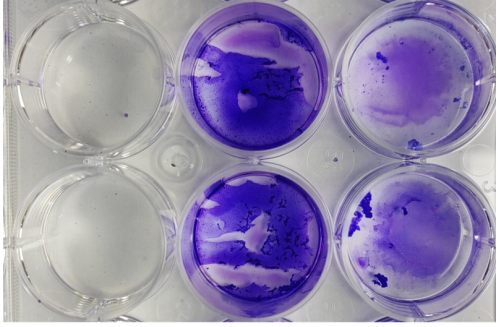
Left: water control; Center: cultured with green algae polysaccharides;Right: conventional culture
Biofilm formation was observed under both conventional culture and green algae polysaccharide-supplemented conditions. The stronger coloration in the green algae polysaccharide treatment indicated enhanced biofilm formation, which may support bacterial colonization on root surfaces and in the rhizosphere.
We also observed stronger inhibitory effects of the fermentation broth against strawberry Fusarium wilt and ginger Fusarium wilt pathogens.
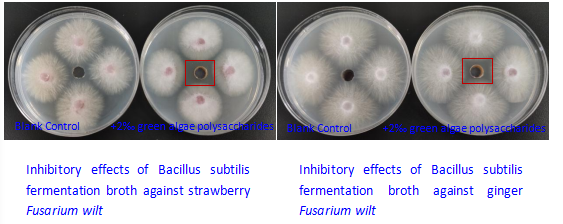
These observations raised another possibility: could the fermentation medium influence not only microbial survival, but also the functional characteristics of the microorganisms?
Green Algae Polysaccharides May Influence Microbial Metabolite Production
Similar trends were observed in our studies of plant growth-promoting metabolites.
Using Bacillus subtilis and Bacillus amyloliquefaciens as test strains, we found that adding green algae polysaccharides increased indole-3-acetic acid (IAA) production by approximately 120% in both strains compared with the conventional culture system.
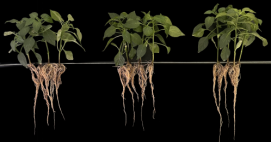
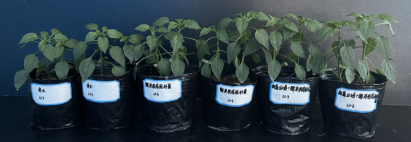
When the corresponding fermentation broths were applied to pepper seedlings, both plant height and fresh weight were higher than those of the control groups.
Test method: Green algae polysaccharides were added to the fermentation medium at 2‰. Pepper seedlings were treated by root drenching with fermentation broths produced with and without green algae polysaccharides. IAA production in the fermentation broths was also measured.
| Strain | Treatment | Plant height (cm) | Fresh weight per plant (g) | IAA (ppm) |
|---|---|---|---|---|
| B. subtilis | Water control | 12.28 | 1.95 | — |
| B. subtilis | Conventional fermentation broth | 14.32 | 2.36 | 18.57 |
| B. subtilis | Fermentation broth + green algae polysaccharides | 15.54 | 2.57 | 40.70 |
| B. amyloliquefaciens | Water control | 12.28 | 1.95 | — |
| B. amyloliquefaciens | Conventional fermentation broth | 13.58 | 2.10 | 16.22 |
| B. amyloliquefaciens | Fermentation broth + green algae polysaccharides | 14.58 | 2.40 | 35.55 |
Growth-promoting effect of Bacillus subtilis on pepper seedlings
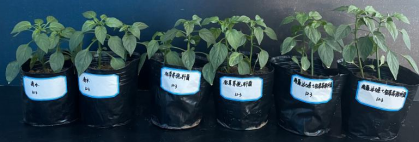
Left: water control; Center: conventional fermentation broth; Right: fermentation broth with green algae polysaccharides
Growth-promoting effect of Bacillus amyloliquefaciens on pepper seedlings
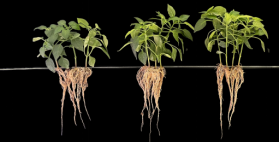
Left: water control; Center: conventional fermentation broth; Right: fermentation broth with green algae polysaccharides
The results suggest that the influence of green algae polysaccharides on agricultural microbial products may extend beyond a single stage of production. Their potential effects can be observed across fermentation, processing, storage, and ultimately microbial performance after application.
Rethinking Fermentation Medium Design for Agricultural Microbial Products
These preliminary findings further support the practical value of the Biostimulatory Fermentation Medium concept.
Traditionally, fermentation media are mainly designed to provide microorganisms with the nutrients required for growth. However, for commercial agricultural microbial products, high microbial biomass alone does not necessarily mean better product performance.
A more complete evaluation should consider whether microorganisms can:
survive processing and storage;
tolerate environmental stress;
maintain or improve their functional characteristics;
colonize plant roots or the rhizosphere; and
produce beneficial metabolites after fermentation.
In other words, fermentation medium design may need to move from simply supporting microbial growth toward influencing the overall functional performance of the final product.
If agricultural microbial products are primarily about whether microorganisms can survive, colonize, and perform, engineered microbial systems raise a different question: how can fermentation conditions direct microbial metabolism toward a desired target product?
In our next article, we will share our findings on the application of green algae polysaccharides in engineered microbial systems and further explore the potential of Biostimulatory Fermentation Medium in industrial biomanufacturing.



 RSS
RSS