


Seawin Biotech has also extended its research on green algae polysaccharides to engineered microbial fermentation. We tested two different systems, Bacillus subtilis and Corynebacterium glutamicum, and measured changes in target product production after adding green algae polysaccharides to the medium.
Bacillus subtilis: Target Product Increased by up to 50.16%
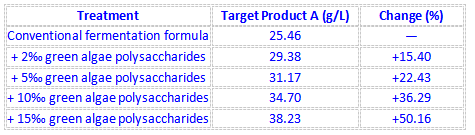
In the Bacillus subtilis trial, green algae polysaccharides were added to the fermentation medium at 2‰, 5‰, 10‰, and 15‰, respectively, and compared with the conventional fermentation formula.
Test strain: Bacillus subtilis
Test method: Green algae polysaccharides were added to the fermentation medium at 2‰, 5‰, 10‰, and 15‰. The amount of Target Product A was measured and compared with the conventional fermentation formula.
Test Results:
Corynebacterium glutamicum: Target Product Increased by up to 38.25%
Results from a single strain may not be enough to establish a clear pattern. We therefore ran the same trial with Corynebacterium glutamicum. A similar trend was observed: Target Product B increased from 18.56 g/L in the conventional fermentation formula to 25.66 g/L at the 15‰ addition level, an increase of 38.25%.
Test strain: Corynebacterium glutamicum
Test method: Green algae polysaccharides were added to the fermentation medium at 2‰, 5‰, 10‰, and 15‰. The amount of Target Product B was measured and compared with the conventional fermentation formula.
Test results:
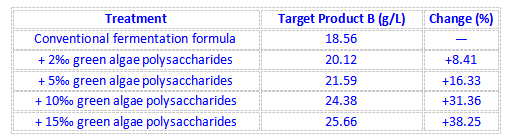
Both strains showed the same general trend: target product production increased as the dosage of green algae polysaccharides in the medium increased.
The two trials revealed an observation that deserves further investigation. Without altering the engineered microorganisms themselves, changes in the functional composition of the fermentation medium resulted in significant increases in target product production.
In the first article of this series, Seawin Biotech introduced the concept of Biostimulatory Fermentation Medium. The idea extends beyond supporting microbial growth through nutrition to consider how a fermentation medium may influence microbial physiological state, functional performance, and target metabolism.
At present, the work remains at the application stage. From agricultural microbial products to engineered microbial fermentation, the mechanisms behind these observations have yet to be clarified and will require further investigation through approaches such as metabolomics and transcriptomics.
Even so, the results raise a practical question: what more can we expect from a fermentation medium than simply keeping microorganisms growing?





 RSS
RSS