


Seaweed Extract Field Trials in Brazil: Yield Gains in Sugarcane, Coffee, Cotton and Soybean
How did a Laminaria japonica-based seaweed extract perform under Brazilian growing conditions? Field evaluations of H’Exal recorded yield increases ranging from 5.9% to 20.9% across four major crops.
Brazil is an important market for agricultural biostimulants, particularly seaweed-based products used alongside conventional crop nutrition programs. But for growers and agricultural input manufacturers, the question remains practical: what results can a seaweed extract deliver in the field?
H’Exal, a seaweed extract product manufactured by Qingdao Seawin Biotech Group and marketed in Brazil through its local partner ALAS, has been evaluated in sugarcane, coffee, cotton and soybean.
The trials compared H’Exal application protocols with growers' standard management practices across several major agricultural regions in Brazil.
Seaweed Extract Field Trial Results: Four Crops, Four Growing Environments
<text preserveWhitespace>{""}</text>
| Crop | Standard Management | H’Exal Treatment | Yield Increase |
|---|---|---|---|
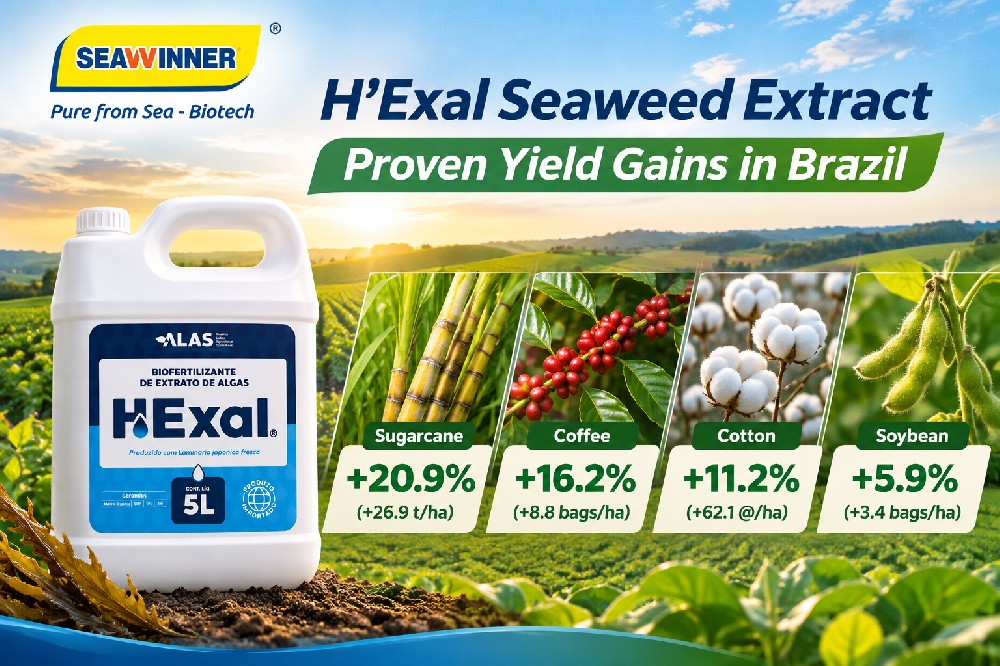
| Sugarcane | 128.7 t/ha | 155.6 t/ha | +20.9% |
| Coffee | 53.9 bags/ha | 62.7 bags/ha | +16.2% |
| Cotton | 554.3 @/ha | 616.4 @/ha | +11.2% |
| Soybean | 58.4 bags/ha | 61.9 bags/ha | +5.9% |
Sugarcane: 26.9 More Tonnes per Hectare
The sugarcane trial was conducted in Angélica, Mato Grosso do Sul, using the CTCadvana01 variety.
Under standard management, sugarcane yield reached 128.7 tonnes per hectare. With the H’Exal treatment protocol, yield increased to 155.6 tonnes per hectare.
This represented an additional 26.9 tonnes per hectare, or a 20.9% increase.
Sugarcane showed the largest percentage improvement among the four crops evaluated.
Coffee: 16.2% Higher Yield in Minas Gerais
In Patrocínio, Minas Gerais, H’Exal was evaluated on the IAC 125 RN coffee variety.
Results reported from evaluations over the last three years in the same area showed 62.7 bags per hectare under the H’Exal protocol, compared with 53.9 bags per hectare under standard management.
The difference was 8.8 bags per hectare, equivalent to a 16.2% increase.
Cotton: 11.2% Average Yield Increase
The cotton trial took place in Luís Eduardo Magalhães, Bahia, using the DP2111B3RF variety.
Three H’Exal application protocols were evaluated. Their average yield reached 616.4 arrobas per hectare, compared with 554.3 arrobas per hectare in the control.
The average increase was 62.1 arrobas per hectare, or 11.2%. One protocol recorded more than 100 additional arrobas per hectare over the control.
Soybean: Yield Improvement Across Three Brazilian Regions
Soybean trials covered Luís Eduardo Magalhães in Bahia, Maracaju in Mato Grosso do Sul, and Campo Verde in Mato Grosso.
The evaluated varieties were BMX Olimpo IPRO, BMX Compacta IPRO and Brasmax Guepardo IPRO.
Average yield increased from 58.4 to 61.9 bags per hectare, with a reported improvement of 5.9%.
Unlike the other crops, the soybean results covered multiple growing regions and varieties, providing field observations under different production conditions.
What Do These Results Tell Us About Seaweed Biostimulants?
The four crops responded differently to the H’Exal application protocols. Yield increases ranged from 5.9% in soybean to 20.9% in sugarcane.
The evaluations covered different crop varieties, production environments and management programs. They offer useful field references for companies considering seaweed extracts as part of their crop nutrition and biostimulant portfolios.
The trials were carried out by local technical teams and agricultural consultants in cooperation with ALAS, Seawin's Brazilian partner, which has a technical and commercial presence in more than 14 Brazilian states.
The reported results reflect the specific treatment protocols and growing conditions evaluated. Application rates, timing and local crop management should be considered when assessing potential performance in other markets.
From Field-Proven Applications to Seaweed-Based Formulation Development
For agricultural input manufacturers, seaweed extract performance in the field is one consideration when selecting bioactive ingredients for new formulations.
Seawin manufactures Laminaria japonica-based seaweed extracts using its enzymolysis-fermentation extraction technology. Its product portfolio includes SEAD STAR, a seaweed-derived Bioactive Formulation Base containing alginic acid and seaweed polysaccharides.
SEAD STAR is designed for manufacturers looking to incorporate seaweed-derived bioactive compounds into fertilizers, biostimulants and other crop nutrition formulations.
Beyond seaweed extracts, Seawin also offers APAA for abiotic stress management and GALA for fruit coloration and quality, together with customized formulation and private-label manufacturing services.
Looking for seaweed extract ingredients or bioactive formulation bases for your product line?
Explore Seawin's seaweed extract solutions or contact our team to discuss product specifications, formulation compatibility and OEM development.




 RSS