


A crop may receive enough fertilizer and still show poor growth. Leaves turn yellow, plants develop unevenly, and growth slows down. Adding more fertilizer does not always solve the problem.
In many cases, the problem starts below ground.
Compacted soil, poor drainage, salt accumulation and low biological activity can all restrict root development. Even when nutrients are present in the soil, damaged or poorly developed roots may struggle to absorb them.
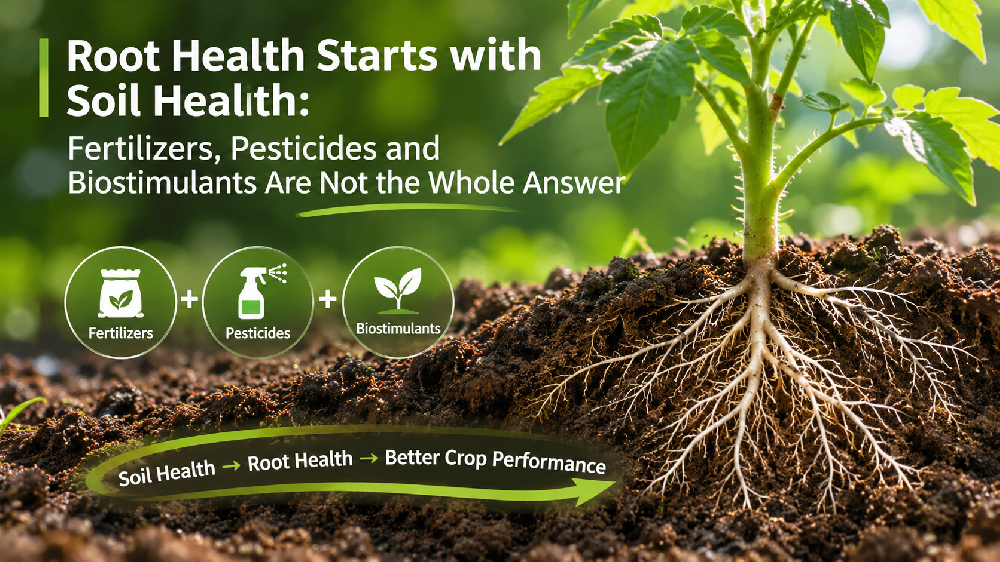
This is why root health and soil health need to be managed together.
What Does a Healthy Root System Need?
Healthy roots do more than anchor a plant. They absorb water and nutrients, interact with soil microorganisms and help crops respond to changing growing conditions.
A healthy root system generally has active root tips, sufficient branching and access to a suitable soil environment. Fine roots are particularly important because they provide much of the surface area involved in water and nutrient uptake.
However, root growth depends heavily on the conditions surrounding the roots.
Soil compaction restricts root penetration and reduces the movement of air and water through the soil. Roots may remain shallow or develop unevenly.
Poor drainage limits oxygen availability. Without sufficient oxygen, root respiration and nutrient uptake are affected.
High salinity makes water uptake more difficult and can expose roots to ion toxicity. Applying additional fertilizer without considering soil salinity may make the situation worse.
Poor nutrient availability is another common problem. A soil test may show sufficient total nutrients, but pH, chemical interactions and soil conditions can limit the amount available for plant uptake.
These problems cannot always be corrected simply by increasing fertilizer rates.
Soil Health Is More Than Soil Fertility
Soil fertility is an important part of soil health, but the two are not identical.
A soil may contain adequate nitrogen, phosphorus and potassium while still having poor physical structure or limited biological activity.
For practical crop management, soil health involves three closely connected aspects:
Physical conditions: Soil structure, porosity, aeration, drainage and water-holding capacity.
Chemical conditions: Nutrient availability, pH, salinity and the balance of soluble ions.
Biological conditions: Microbial activity, organic matter decomposition and interactions between roots and soil organisms.
These factors influence each other. Poor soil structure can reduce oxygen availability, affecting both root growth and microbial activity. Changes in soil pH can influence nutrient availability, while root exudates help shape the microbial community around the roots.
Improving soil health therefore requires more than adding nutrients. It requires attention to the environment in which roots actually grow.
Where Can Biostimulants Help?
Biostimulants are not a substitute for proper irrigation, drainage, soil management or balanced fertilization. Their value lies in supporting specific plant and soil processes alongside these practices.
Different biostimulant ingredients serve different purposes.
Humic and Fulvic Acids: Supporting the Root-Zone Nutrient Environment
Humic substances can interact with soil minerals and nutrients, influencing nutrient retention and availability.
Humic acid-based materials are commonly used in soil-conditioning programs, particularly where improving nutrient retention and root-zone conditions is a priority.
Fulvic acid, with its relatively low molecular weight and functional groups, can interact with mineral nutrients and is widely used in fertigation and specialty fertilizer formulations.
The practical objective is not simply to increase the amount of fertilizer applied, but to help crops make better use of nutrients already supplied.
Seaweed Extract: Supporting Root Development and Crop Establishment
Seaweed extracts contain a mixture of naturally occurring compounds, including polysaccharides, alginates and other bioactive substances.
Depending on the seaweed source, extraction process and formulation, these compounds can support root development, nutrient utilization and crop responses to environmental stress.
Seaweed-based biostimulants can be particularly useful during seedling establishment, transplanting and periods when root activity is affected by unfavorable growing conditions.
They should be viewed as a complement to an effective nutrition program, rather than a replacement for essential nutrients.
Beneficial Bacillus: Working in the Rhizosphere
The rhizosphere is the narrow zone of soil influenced by plant roots. It is also where many important interactions between plants and microorganisms take place.
Selected Bacillus strains can contribute to nutrient mobilization, produce metabolites associated with plant growth and compete with certain undesirable microorganisms.
However, microbial performance depends on the strain, formulation and field conditions. Soil temperature, moisture, pH and existing microbial communities can all influence the outcome.
For this reason, microbial products should be evaluated under the intended growing conditions rather than assuming that the same results will occur in every soil.
Poly-γ-Glutamic Acid: Supporting Water and Nutrient Management
Poly-γ-glutamic acid (γ-PGA) is a biodegradable polymer with water-binding properties.
In suitable formulations, it can help manage moisture and nutrient availability in the root zone. This makes it an interesting component for root establishment and water-management applications.
Its contribution depends on application rate, formulation and soil conditions, and it should not be considered a replacement for adequate irrigation.
Matching the Solution to the Root Problem
Not every field needs the same soil or root treatment.
Where soil compaction is the main limitation, improving soil structure and reducing traffic-related compaction should come first. A biostimulant cannot replace the physical correction of a severely compacted soil.
Where salinity is restricting root activity, irrigation water quality, drainage and salt management must be considered before selecting supplementary inputs.
For crops struggling after transplanting, the priority may be supporting new root growth and early nutrient uptake.
Where nutrient availability and rhizosphere activity are the main concerns, humic substances, fulvic acid and suitable microbial products may be useful components of the program.
At Seawin Biotech, our soil and root-zone portfolio includes different approaches to these needs:
Root Promoter: A seaweed-based formulation combining Laminaria japonica extract, γ-PGA and nutrients, developed for transplanting and early root establishment.
Root Shield: A formulation combining beneficial Bacillus and biostimulant components to support root recovery and the rhizosphere environment.
Synergy: A Bacillus subtilis-based microbial product developed for rhizosphere activity and nutrient availability.
Potassium Humate and Fulvic Acid: Functional ingredients for soil conditioning, nutrient management and specialty fertilizer formulations.
These products address different aspects of root and soil management. The appropriate choice depends on the crop, soil conditions, application method and the problem being addressed.
How Do We Know Whether Root Health Is Improving?
A greener canopy is encouraging, but it does not tell the whole story.
For a meaningful field evaluation, it is useful to look at both root development and crop performance.
Root length, root mass, fine-root development and root distribution can provide useful information, especially when comparing treated and untreated plants at the same growth stage.
Soil measurements also matter. Depending on the problem, these may include electrical conductivity (EC), pH, moisture, infiltration or soil compaction.
Ultimately, improvements should be evaluated against practical outcomes such as crop establishment, nutrient uptake, uniformity, yield and quality.
The evaluation period is important. Root-zone treatments may not produce an obvious response within a few days, particularly in perennial crops. Trials should cover an appropriate growth stage and include a suitable control.
Better Roots Begin with Better Growing Conditions
Healthy roots and healthy soil reinforce each other. Roots depend on suitable soil conditions, while active root systems contribute organic compounds and biological activity to the rhizosphere.
Fertilizers remain essential for crop production, but supplying nutrients is only part of the process. Those nutrients must also be available to the plant, and the root system must be capable of absorbing them.
For growers and fertilizer formulators, the practical question is not simply which product promotes root growth. It is what is limiting root growth in the first place, and which combination of soil management, nutrition and biostimulants can address that limitation?
Seawin Biotech develops marine-derived biostimulants, microbial products and specialty fertilizer ingredients for different soil and root-zone applications. We work with partners to develop formulations and application programs suited to local crops and growing conditions.



 RSS